

An Underestimated Risk: The Growing Complexity in Process Planning
The pharmaceutical and biopharmaceutical industry is characterized by strict regulatory requirements (FDA, GMP) and increasingly shorter time-to-market cycles. Designing and validating plants for sterile fluid transfer demands the highest level of precision. The heart of this planning phase is the Piping and Instrumentation Diagram (P&ID) – but the P&ID is just the schematic. What actually defines the entire process logic, all physical components, and the flow paths of the media is the subsequent Process Design phase, which sits exactly between the P&ID creation and automation.
Historically, however, these diagrams have mostly been treated as purely static drawings. A classic P&ID shows how a plant is constructed – but it doesn't "think" along. In a dynamic project environment, this inevitably leads to massive problems. Modifications do not just happen once at a late stage; they happen over a hundred times per P&ID, and often a dozen times even after the approval of the P&ID. Because of this sheer volume of changes, it becomes incredibly cumbersome to update all related documents. Whether it is a routine adjustment or a so-called "late-stage redesign" identified during FAT (Factory Acceptance Test), SAT, or even qualification, corrections at a later stage are extremely expensive and can set the project schedule back by months.
The "Highlighter Dilemma" in Everyday Engineering
In everyday process design, engineers, project managers, and qualification leads know this scenario all too well: The initial P&ID is created, but then a short-notice adjustment is required. Perhaps a valve needs to be added, or just the specification of an existing component needs to be changed. What sounds trivial triggers an unmanageable chain reaction in reality.
The entire functional design specification, equipment module setup, sequential flow chart and valve matrices must be adjusted. Every possible variation of the fluid stream must be rethought, verified, and documented. In many engineering offices, this is still largely done manually today: Printed plans are spread out on the table, and the flow paths of the various media (Product, WFI, CIP, SIP) are literally traced with different colored highlighters – resulting in "hand-colored valve states."
The time lost due to this working method is immense. Even more critical, however, are human errors: A single misinterpreted valve or an overlooked pipe section inevitably leads to system malfunctions, such as undetected dead-legs or unwanted cross-contamination.

The Paradigm Shift: The Right Process Design Software
To eliminate these immense project risks, digital process design in the pharma, semiconductor, and food & beverage industries addresses exactly this pain point. However, the solution is not to replace proven CAD systems with entirely new, isolated standalone solutions.
AseptSoft was developed as a specialized Process Design Software that integrates as an add-in directly into widely used platforms like AutoCAD Basic and AutoCAD Plant 3D. Engineers do not have to learn a new CAD environment or fear complex IT migrations. They continue to work in their familiar system landscape, which is upgraded with an intelligent layer through the plugin or with AseptSoft Standalone if they are not using AutoCAD.
Since Aseptconn AG has profound, real-world expertise in sterile fluid transfer components, this system is made by engineers for engineers. It exactly reflects the physical behavior of the hardware – from single-use hoses to complex valve manifolds – in the digital space. This subtle but crucial bridge between hardware know-how and software logic makes all the difference.
From Static Construct to Intelligent P&ID
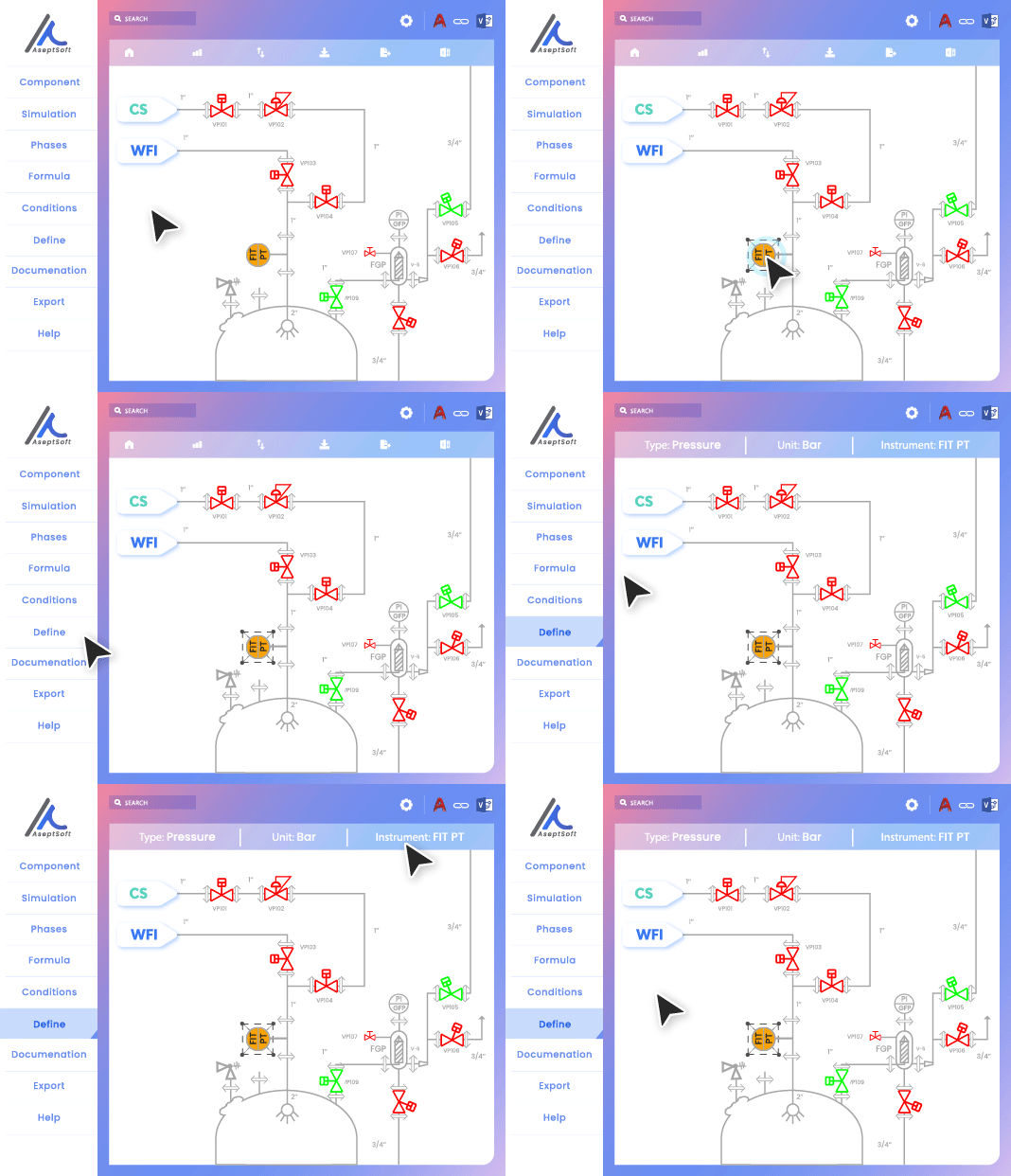
Through this integration, the transition to an Intelligent P&ID takes place. Every component is backed with specific metadata and logical dependencies. AseptSoft knows the state of every valve, simulates fluid paths, and updates the process to changes automatically.
The Flow Path Simulation is a foundational feature: If a process engineer changes the state of a valve (e.g., from "closed" to "open"), the software immediately shows the consequences. The lines and pipes in the plan automatically change color according to the present media and pressures. Valves, pumps, and tanks are clicked in the model – not drawn.
However, the real benefit goes far beyond the visual simulation. When the flow path is correct, the process linked in the P&ID becomes a true "Single Source of Truth." From there, all related documents can be extracted, updated, and set up automatically. You have your Sequential Flowcharts (SFC), Functional Design Specifications (FDS), Valve Matrices, and "Picassos" (highlighted P&IDs) all ready with a single mouse click.
Hard Facts: Massive Reduction in Time-to-Market
This automated "proof of concept" in the design phase brings an unprecedented return on investment for B2B projects. Errors become visually apparent before they have consequences.
The ROI is measurable: In a documented real-world application, the effort required for the process design phase of a standard plant was reduced from 5 weeks to just 3 hours. This massive leap in efficiency is due to the automation of the fluid path simulation and the elimination of time-consuming, manual drawing and documentation tasks.
Who Is This Software For? A Win for All Disciplines
AseptSoft addresses the core problems of various stakeholders in the pharmaceutical and biopharmaceutical industry:
- Process Engineers: Profit from drastically reduced drawing work. Fewer inquiries, fewer manual correction rounds, and more time for actual, value-adding engineering. Process adjustments can be made at any project stage without redrawing the model.
- Qualification Engineers / QA: The accompanying documentation, which quickly spans hundreds of pages, no longer needs to be updated manually. Functional Design Specifications (FDS), IQ/OQ reports, and valve status lists are exported compliantly and 100% digitally with a single click (PDF or tabular).
- Automation Engineers: The software generates structured I/O tables, algorithms, parameters, and variables directly from the verified P&ID – a seamless handover to the automation department without interface losses (SCADA-ready).
- Buyers & Project Managers: Gain absolute transparency over the project status. The risk of erroneous hardware purchases is minimized, timelines become realistic, and the substantial risk of changes (late-stage redesigns) drops dramatically.
Conclusion: Not a Luxury, But Tomorrow's Standard
The pharmaceutical and biopharmaceutical industry is under constant pressure. Anyone who continues to work with printed P&IDs and manual documentation in this environment loses time, budget, and jeopardizes compliance.
Digital process engineering is not a vision of the future. The transformation from a static plan to a smart, simulation-capable model through seamless plugin integration is available today and field-tested. If you want to structurally minimize project risks and maximize efficiency, you need to design dynamically today.
Take the next step: Experience for yourself how a simulated P&ID revolutionizes your process planning, and test the system directly in your own CAD environment. Ask for our 3-Month Pilot Program. This paid program ensures your success by providing full support, comprehensive training, and initial P&ID setup (when necessary) right from the start.