
Key to success
Choosing the right valve for an industrial system is a key factor in guaranteeing the performance and longevity of the installation. A well-considered selection that aligns with the technical specifications (URS – User Requirement Specification) ensures not only that the application requirements are met but also optimises costs and operational efficiency. Below are the key criteria to consider when making this strategic decision.
The main parameters: Focusing on essentials
To make an effective selection, it is important to evaluate several fundamental aspects:
- Nature of fluids: A thorough understanding of the chemical and physical properties of the fluids is essential for selecting a suitable valve. For example, chemical compatibility ensures that the valve components are not damaged by the fluid, while viscosity directly influences the choice of valve type and design to ensure smooth and unobstructed flow.
- Temperatures: Determining the operating temperature ranges is critical for selecting materials that can withstand significant temperature fluctuations without compromising tightness or durability. Applications involving high temperatures require special materials such as specific alloys or seals that can endure extreme thermal stress.
- Pressure and ∆P (DeltaP): Knowing the pressure requirements the valve will face, as well as pressure fluctuations (∆P), is essential. This information ensures the valve operates optimally and can handle pressure variations without affecting performance.
- Flow rate: Assessing flow requirements helps determine the optimal valve size and hydrodynamic properties. Insufficient flow can lead to significant pressure losses, while oversizing can result in efficiency losses and unnecessary additional costs.
- Environment: External conditions such as humidity, dust, controlled atmospheres (e.g., cleanrooms), extreme temperatures or risks like explosions (ATEX) or corrosion significantly influence the choice of valve components and materials.
- Sterilisation and autoclaving: In industries such as pharmaceuticals, medical or food, where high sterilisation requirements exist, valves must withstand frequent autoclaving cycles at temperatures up to 140°C without losing their tightness.
- Cleaning: Cleaning procedures like CIP (Cleaning in Place) or COP (Cleaning Out of Place) also affect valve selection. An optimised design minimises the risk of cross-contamination and facilitates maintenance. Interior and exterior surfaces should be smooth to prevent residues.
- Number of opening and closing cycles: For applications with high usage intensity, it is essential to ensure the valve can withstand a high number of cycles without failing. This includes selecting high-quality, wear-resistant mechanical components.
Secondary parameters: Details that make a difference
Although considered secondary, these elements play a critical role in optimising performance and valve selection:
- Outer diameter and wall thickness / Pipe classes and standards: Ensuring compatibility with existing installations by adhering to pipe classes and applicable standards is important. This includes precise dimensions to avoid costly adjustments or incompatibilities during installation.
- Connection types: Connection choices should consider the specific application requirements, particularly regarding maintenance and disassembly. Quick couplings can be useful for frequent operations, while welded connections provide maximum tightness for critical applications.
- Surface finish and electropolishing: A smooth and well-finished surface reduces the risk of residues and contamination. Electropolishing is especially recommended in industries with high hygiene standards, as this process improves corrosion resistance and facilitates cleaning.
- Membranes and seals: These components should be selected based on the properties of the fluid (acids, bases, solvents, etc.) as well as temperature and pressure conditions. Seals made from silicone, PTFE, or EPDM are suitable for many industrial applications, but their selection depends on specific requirements.
To identify the most suitable material for your application, we invite you to complete our compatibility form. It will help you determine the optimal materials for your specific application.
- Actuation type: The choice between pneumatic, electric or manual actuation should reflect automation and operational efficiency requirements. The so-called fail-safe or no-energy position should ideally align with the equipment’s functional analysis.
- Pneumatic pressure: If a pneumatic actuator is used, assessing the available pressure is crucial to ensure reliable operation. Insufficient pressure can affect the proper opening or closing of the valve.
- Accessories and automation: Integrating sensors, feedback systems or intelligent control and regulation components can significantly enhance the central management of valves. These accessories facilitate remote monitoring, optimise performance and minimise human error.
Types of Valves
- Diaphragm valve
 The diaphragm valve is particularly used in applications where hygiene and precision are crucial, especially in the pharmaceutical, food, and chemical industries. It allows for the control of fluid flow while ensuring perfect sealing through a flexible diaphragm that deforms upon actuation, blocking the fluid passage. These valves are ideal for sterile, viscous, corrosive or sensitive fluids, as no moving parts come into direct contact with the fluid, reducing the risk of contamination. Often, multiple valves are combined into a single machined block, significantly reducing internal volumes and dead spaces.
- Bottom drain valve
 The bottom drain valve is primarily used in applications where a tank or container needs to be emptied safely and efficiently with minimal dead volume. It is installed at the bottom of containers to drain fluids or residues. These valves are often designed for solid or pasty products and are used in the chemical and food industries for cleaning or draining processes.
- Ball valve
 Ball valves, also known as rotary ball valves, are commonly used to quickly open or close the flow of fluids. They are known for their simplicity and efficiency. A perforated ball controls the flow by rotating to open or close the passage. These valves are ideal for handling viscous fluids or solvents in the chemical and food industries (e.g., oils, sugary liquids, cleaning products) or pure steam in the pharmaceutical industry.
- Pressure control valve (pressure reducing valves)
 Pressure reducers are used to autonomously regulate the pressure of a fluid in a system and reduce it to a safe and optimal level. They protect sensitive equipment by reducing pressure before distribution in networks. For example, they are indispensable for supplying systems with purified water or pure steam and for controlling gas or liquid flows in reactors or fermenters.
- Back pressure regulator valve (overflow valve)
 Back pressure regulator or overflow valves are used to maintain constant pressure on the inlet side of a system. These valves are often used in return systems for purified water, pump systems, liquid treatment systems and chemical production processes, where precise pressure control is required to ensure efficiency and safety.
- Control valve
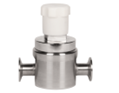 Control valves are used to regulate flow or pressure in a system. They are suitable for applications where flow, pressure or temperature in critical processes need to be precisely adjusted. Such valves are particularly useful in dosing lines or heating systems in the food or chemical industry, where the highest precision is required to ensure product quality.
Temperature control valve
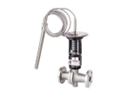 Temperature control valves are designed to maintain the temperature of a fluid within a specified range. They are indispensable for systems used for pasteurisation, cooling or heating in the production of pharmaceutical products, creams or beverages.
Air vent valve
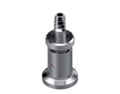 Air vent valves are used to release air or other unwanted gases from a pipeline system or tank. They are crucial in the pharmaceutical and biotechnological industries to ensure the homogeneous distribution of fluids in production lines for purified water or sterile solution.
Sampling valve
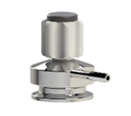 Sampling valves are specifically designed to extract sterile or controlled samples during production processes without compromising product integrity or contaminating the system. They are used in the pharmaceutical and biotechnological industries for validation and quality control, as well as in the food and cosmetics industries to ensure product standards are met.
Conclusion
Selecting the appropriate valve for a specific application requires a thorough analysis of various technical parameters. The properties of fluids, temperature, pressure and cleaning requirements play a key role in optimising the performance and durability of the system. Attention to details such as the type of actuator, connections or automation will make a difference in long-term efficiency.
In this context, Aseptconn stands out as a leading supplier of process fittings. With our recognised expertise and a wide range of products that meet the highest standards, we are your ideal partner for selecting the optimal solution for your industrial requirements. With a consistent commitment to quality and innovation, Aseptconn guarantees reliable, high-performance valves perfectly tailored to your specifications.