
What single-use assemblies deliver
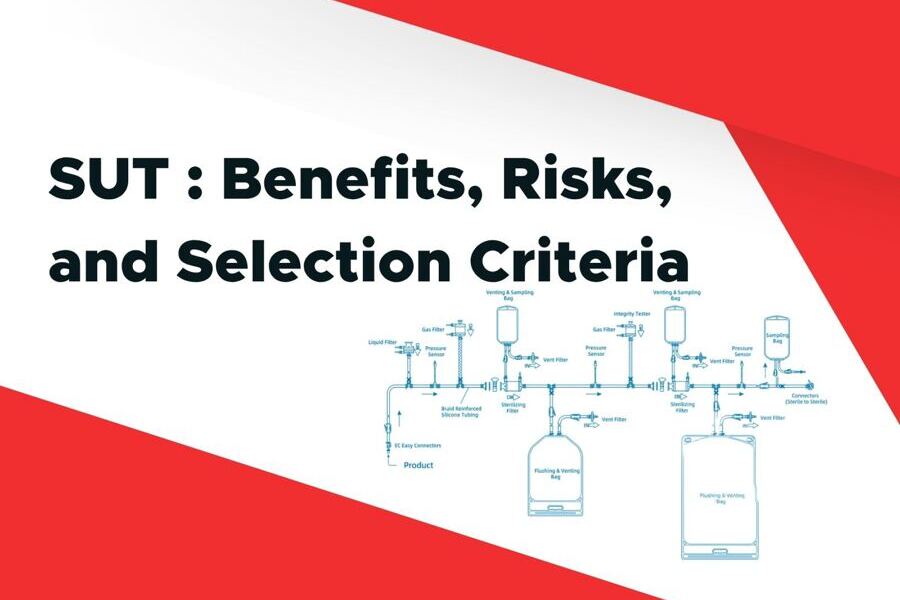
A single-use assembly is more than the sum of its components. It combines tubing, connectors, filters, bags, valves, and sensors into a ready-to-connect unit designed for a single production cycle. After use, the entire system is discarded – cleaning (CIP) and sterilization (SIP) are eliminated.
The key advantages over classic multi-use systems:
- Lower contamination risk: Pre-sterilized, closed systems significantly reduce the risk of cross-contamination.
- No cleaning and sterilization: No demanding CIP/SIP cycles and no cleaning validation for the affected fluid paths.
- Faster product changeovers: Higher plant utilization and productivity, especially in multi-product facilities.
- Lower operating costs: Significantly reduced consumption of water, energy, and cleaning chemicals.
- Greater flexibility: Processes can be redesigned, scaled, and adapted to new products more quickly.
- Improved process consistency and traceability: Standardized units with end-to-end documentation.
Particularly in fast-moving biopharma development – where time-to-market often determines project success – single-use technology noticeably accelerates implementation and scale-up.
The flip side: risks and limitations
As compelling as the benefits are, single-use is not a sure-fire success. Anyone who underestimates the specific risks merely shifts cost and effort to later phases of the project.
Extractables & leachables (E&L): Polymeric materials are in direct contact with the process fluid. Under certain conditions, substances can migrate from the material and compromise product quality or patient safety. Material selection without a sound compatibility assessment is one of the greatest risks of all.
Supply chain dependency: A disposable system must be reliably available in consistent quality. Shortages of critical components or short-notice material changes by suppliers can bring entire production lines to a standstill.
Validation and documentation effort: Eliminating cleaning validation does not mean the end of regulatory effort. Certificates, material evidence, sterilization records, and batch traceability must be available without gaps.
Waste and sustainability: Disposable systems generate more solid waste. Depending on the site and sustainability strategy, this is a relevant trade-off factor.
Selection criteria: what really matters
The decision for a specific assembly should be made along a few core criteria:
- Material compatibility and E&L profile – matched to process fluid, temperature, pressure, and contact time.
- Fluid dynamics and layout – choose tubing dimensions and arrangement so that dead legs, trapped air, and flow problems are avoided.
- Connectors and interfaces – aseptic connections that fit the existing facility concept and the process steps.
- Documentation and certification – complete, ideally digital evidence from the outset, so as not to delay validation and approval.
- Availability and scalability – qualified, readily available components that make the leap from development to production.
- Design complexity – as simple as possible; every unnecessary component increases the risk of error and failure.
Top mistakes when specifying single-use assemblies
In practice, projects rarely fail because of the technology itself, but because of avoidable specification mistakes. The five most common:
1. Fluid dynamics are not considered (very common). Flow routing addressed too late leads to poor flow, dead legs, or trapped air. Solution: optimize tubing dimensions and assembly layout early – ideally supported by simulation.
2. Incorrect material selection (very common). Unsuitable materials cause extractables/leachables or chemical incompatibility. Solution: select materials based on the specific process requirements and with compatibility testing.
3. Supply chain and scalability are neglected (common). The result is production delays or costly redesigns. Solution: choose qualified, readily available components and plan for scale-up from the start.
4. Certification and documentation are underestimated (common). Incomplete evidence delays validation and regulatory approval. Solution: ensure compliant materials and complete documentation from the start.
5. Other common mistakes. Overly complex designs, insufficient testing before implementation, and poor communication of process requirements.
The common denominator of these mistakes: they arise early – in the design and specification phase – and become expensive later. Anyone who considers fluid dynamics, material choice, documentation, and supply chain together from the start eliminates most of the later problems. This is precisely where a partner who not only supplies but also thinks along pays off.
From component to a partner who thinks along
Single-use assemblies only deliver their value when they are understood as an application-specific overall solution – not as a string of standard components. The difference is made by a partner who accompanies the entire life cycle: as a forward thinker in design, as a collaborator in material selection, as a manufacturer in its own production, and as a companion across the entire supply chain.
This is exactly how Aseptconn sees itself – a comprehensive partner to the biopharmaceutical industry:
- Engineering & forward thinking: Design of application-specific assemblies from the first sketch through P&ID creation to flow-optimized construction, with CFD simulation on request.
- In-house cleanroom manufacturing: Assembly of the units in our own ISO Class 7 cleanroom production in Switzerland – with rapid prototyping and quotes often within 48 hours.
- Complete validation & digital certificates: Full validation of the assemblies with gap-free, digitally available documentation and complete traceability – simplifying your own qualification and approval.
- Supply chain support: Safeguarding continuity of supply – where needed via consignment stock at your site or stock held at our premises as your supplier.
- Open architecture: Manufacturer-independent integration of the components best suited to your real process.
Anyone who approaches single‑use with a structured, end‑to‑end perspective gains what matters most in biopharma: saf