

1. What are pipe-flow calculations?
Pipe-flow calculations are based on one-dimensional flow models, in which fluid parameters are evaluated along the pipe axis. They are used to predict the global operating parameters of pipe-based systems.
The main calculated parameters include:
- pressure losses,
- flow rates,
- flow velocities,
- temperatures,
- heat transfer.
These simplified models do not provide information on local three-dimensional phenomena such as turbulence distribution or concentration gradients.
Typical Applications in Pharmaceutical Utilities
Pipe-flow calculations are particularly suited for large and complex distribution systems, such as:
- PW and WFI loops,
- Clean Steam and Pure Steam systems,
- compressed air and nitrogen networks.
They are commonly used for:
- pipe sizing,
- pump and heat exchanger selection and sizing,
- configuration of pressure and back-pressure regulators,
- loop balancing (orifice flow calculations),
- simulation of worst-case operating scenarios (all points of use closed, partial load, maximum demand).
Pipe-flow calculations answer a fundamental question:
Will the system operate correctly at a global level under all defined conditions?

2. What Are CFD Simulations?
CFD, or Computational Fluid Dynamics, is based on solving complex physical equations describing fluid flow, heat transfer, turbulence, and multiphase phenomena.
Unlike pipe-flow calculations, CFD provides detailed three-dimensional distributions of process parameters, including:
- velocity and pressure fields,
- temperature profiles,
- concentration gradients (powders, dissolved phases, gases),
- kLa and gas holdup in bioreactors.
Typical Applications in Pharma and Biotech
CFD simulations are used for detailed analysis of specific components or processes, such as:
- mixing tanks and bioreactors,
- powder suspension and dissolution,
- mixing of miscible and immiscible liquids,
- heating and cooling processes,
- filling needles and spray balls,
- sterilization processes.
CFD Deliverables
A CFD study typically includes:
- visualizations (images and videos of flow and temperature fields),
- graphs showing the time evolution of key parameters,
- technical analysis with engineering recommendations.
CFD simulations answer another key question:
What happens locally inside a component or a process?

3. Why Calculations and Simulations Are Essential
Linear Intuition vs. Non-Linear Process Reality
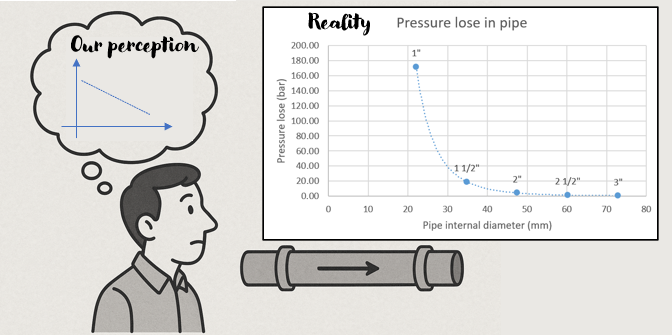
Human intuition is largely based on linear and proportional reasoning, shaped by everyday experience. In contrast, industrial processes — especially fluid dynamics — are often highly non-linear.
In piping systems, reducing pipe diameter does not lead to a proportional increase in pressure losses. Small geometric changes can result in very large pressure increases.
Without calculations, these effects are frequently underestimated, leading to:
- incorrect equipment sizing,
- excessive energy consumption,
- high mechanical stress,
- process instability.
4. Mixing Processes: A High-Risk Area Without Simulation
Mixing operations in tanks and bioreactors exhibit strongly non-linear behaviour:
- mixing time,
- turbulence intensity,
- gas dispersion,
- mass transfer (kLa).
These parameters cannot be reliably extrapolated using simple proportional rules. Changes in tank geometry or agitator design can significantly alter fluid dynamics.
In such cases, CFD simulations are often essential to ensure process performance and reproducibility.
5. Risk and Cost Reduction Through Predictive Engineering
The main objectives of pipe-flow calculations and CFD simulations are to:
- accurately predict process behaviour,
- prevent design-stage failures,
- reduce costs related to commissioning, validation, and late design changes.
In pharmaceutical environments, a design error can lead to:
- costly redesign and rebuild activities,
- production delays,
- significant impact on project timelines and profitability.
Early-stage predictive engineering significantly reduces these risks.

6. When to Use Pipe-Flow Calculations or CFD Simulations?
Engineering Need | Recommended Tool | |
Utility distribution systems | Pipe-Flow Calculations | |
Global pressure / flow balancing | Pipe-Flow Calculations | |
Worst-case operating scenarios | Pipe-Flow Calculations | |
Mixing and suspension analysis | CFD-Simulation | |
| CFD-Simulation |
The most robust designs combine both approaches.
7. Conclusion
Pipe-flow calculations and CFD simulations are neither interchangeable nor competing methods. They are complementary engineering tools, addressing different aspects of pharmaceutical process design.
- Pipe-flow calculations ensure global system performance and reliability.
- CFD simulations provide detailed insight into local phenomena where non-linear behaviour dominates.
In regulated pharmaceutical and biotech environments, combining engineering experience with rigorous calculations and simulations is essential to achieve safe, efficient, and compliant processes.